


The English Setter Association
President: Mrs V. Foss. Secretary: Mr J. F. Bowen. Chairman: Mr Philip Gardiner-Swann. Treasurer: Mr A. E. Jenkins.
THE LAST war seriously interrupted the showing and breeding of dogs, especially the medium to large sized. Owing to the restrictions the number of English Setters in the country had reached an all-time low.
Thinking of the future many of the responsible breeders and owners at that time considered it opportune to found a Club and it was in the Spring of 1951 that the English Setter Association was founded and registered. (The 1951 KC registrations for English Setters were 382.) There were 41 founder-members (some still active in breeding and judging today). There is little doubt that the foresight and enthusiasm of Mrs Fanny Webster (Emeraldisle) and her husband of Fillangley, Coventry (the first secretary and treasurer respectively), were largely responsible for the well-laid foundations of the Association.
The object of the club was to "promote the breeding of pure English Setters" to define and publish true type; to urge the adoption of such type on breeders, judges, etc., as to the standard of excellence by which they should be judged; to hold and support shows and Field Trials, and to encourage the closest understanding between their promoters and breeders, and to adopt such other means as may be deemed advisable for the improvement of the breed".
Thousand members
The first year of the Association (1951) saw 110 members enrolled — today we can boast of just over 1,000. The first show (benched) was held on September 29, 1951 at Westfield House, Radford Road, Coventry. President: Mr A. C. Crowther. Chairman: Mr P. H. Holme. Judge: Mr William East. 82 English Setters entered making 180 entries in 18 classes (one class being 'not for competition'). Best Dog — Mrs A. C. Crowther's Rombolds Templar (who, at the time, had won six CCs), he was by Rombolds Tempest ex Rombolds Fan. Runner-up; Mrs I. G. Duncan's Finnason of Fermanar, bred by Miss K. Lewis by Silver Prince ex Fiona of Fermanar. Best Bitch: Mrs M. A. Phillips' Archdale Sapphire, bred by Miss E. M. Clarke by Archdale Corncrake of Haverbrack ex Heatherdrake Dianne. (Sapphire was sister to Sh Ch Riplegae Mallory.) Runner-up, Mrs S. Christopher's Delora of Elsiville, bred by Mrs E. Ford by Champion Drumgannon Daybreak, ex Jenifer of Elsiville. All these bloodlines feature behind so many of the top winners of the present day.
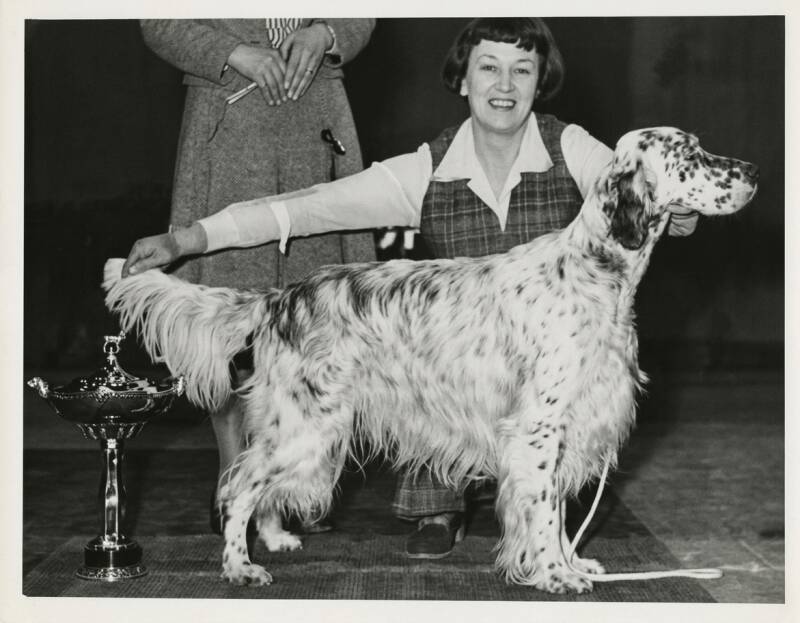
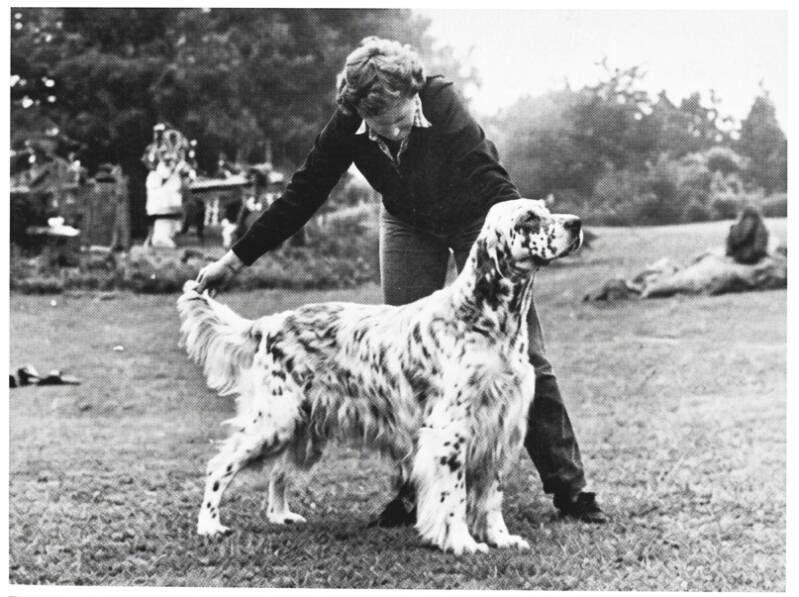
Two Open Shows followed — 1952, Mrs Davis H. Tuck (USA) judged; 1953, Mrs Lola MacDonald Daly adjudicated. The Association was given championship status in 1954, again the show was held at Westfield House — judge Mr Frank Warner Hill — (incidentally the entry fee was 10/6d members, 12/6d non-members, benching 2/6d, catalogue 2/6d. Prize money: 1st — £2, 2nd — £1, 3rd — 10/6d)!!!
Each year afterwards the Championship Show entries increased. After the 17th Ch Show, when I judged 224 English Setters making 412 entries, it was decided to appoint two judges — that entry considered too heavy a work-load for one person.
Rescue fund
The Association runs one Championship Show per year; two Open Shows, a few matches and fund-raising Exemption Shows, usually in aid of The English Setter Rescue Fund (which will soon become a registered charity) and is run by Mr and Mrs A. E. Jenkins (Penycae). Annually there is an 'At Home' for pet and companion owners at Bradford-on-Avon, Wiltshire (we have just held our twelfth). We have a Year Book — our president, Valerie Foss, undertakes responsibility for this; two News Letters per year for which I collate material; these are well-known established features of the Association, often being quoted in the national dog press and other breed publications. Members are extremely good about sending contributions and it is due to their interest and help that they are so successful.
Over the years we have had our full share of talks from veterinary practitioners and specialists (long before regional symposiums were thought of) on such subjects as canine hip dysplasia, skin conditions, pancreatic disorders, middle-ear infections, feeding of balanced foods, acupuncture and homoeopathic treatment. The committee always aware of the need to be forward thinking, were one of the first to enquire into and conduct a survey into canine hip dysplasia in the breed, during 1971. Forums, teach-ins, photographic competitions and displays, showing the English Setter in art, regularly take place.
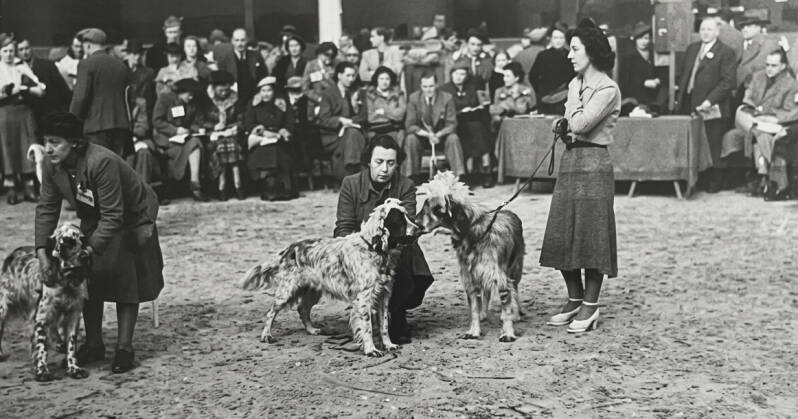
Mrs Fanny Webster showing Malrey of Emeraldisle at Crufts 1952 (interesting to note saw-dust on the floor at Olympia, something we do not now see). Mrs P. Gardiner-Swann is in the middle with Silbury Banner of Bourne and Mrs D. E. Borrowdale is standing with Typhoon of Frejendor. Typhoon later became a Sh Ch but was not at this show. The judge on the day was Mr A. Ashworth.
Interest
Although field trials were included as one of the original objects of the Association we may have, unfortunately, fallen down on this aspect of our responsibilities, but those breeders who have been genuinely interested have found their own way in this activity and produced satisfying results. It should not be forgotten that there are many English Setters used privately for shoots, whose owners have no wish to take part in field trials but, in their own way, help to preserve the natural instincts of the breed.
During the past 35 years, since the club's inception, we have been served by seven presidents, six chairmen (two twice), seven secretaries and nine treasurers. Due to the increasing interest in the breed there are now five regional clubs in addition to the parent organisation.
I have enjoyed being part of all the history, activities and changes of the Association (having been a past president for 13 years). I trust the future of the breed will be studied carefully, breeding programmes planned, and the original objectives of the formation of the Association not 'lost sight of' in the short-term interest of commercialism.
Patricia M. Gardiner-Swann